
The idea of home has never been a stable, physical place for me. When I was born, a war decided by leaders on the other side of the globe shaped every aspect of my family's life. In our northeastern Lao villages and towns, the sound of conflict was constant, and so was the feeling of impermanence. My earliest memories are of being ready to move at any moment, never fully settling, always waiting for the next sign that it was time to leave. In 1979, my elders made a decision that would change everything: we fled to Thailand. That choice set in motion what became a life of perpetual displacement. On April 13, 1980, my family and I arrived in Minnesota as refugees from Laos. I grew up in St. Paul, later lived in Minneapolis for more than a decade, and eventually moved to Wisconsin in August 2006 to join the history faculty at the University of Wisconsin-Milwaukee.
For more than twenty years, I have devoted myself to studying and writing about the Hmong refugee experience — how families like mine, scattered across the globe, rebuilt their lives from nothing. Across communities large and small, one struggle persists: the fight for recognition of Hmong sacrifices during the U.S. Secret War in Laos, a war that ran parallel to the Vietnam War. Thousands of Hmong men and boys were conscripted into a secret army, trained and funded by the U.S. Central Intelligence Agency (CIA), to fight in support of American military objectives in Vietnam. It was a covert operation, hidden from the American public. Only after the U.S. withdrew in 1973 and waves of refugees fled Vietnam, Laos, and Cambodia following the communist takeovers in 1975 did Americans begin to learn of the Hmong’s role.
When thousands of refugees began arriving in the United States, many Americans viewed the Hmong as primitive, convinced that we would never survive in modern American society. While faith-based communities and individuals opened their homes and churches to welcome us, some local residents in towns and cities across the country treated us as people who did not belong in America. In Wisconsin, Hmong families were scattered across the state and, over time, chose to build communities wherever they had landed. From the first arrivals in 1975 to 2020, the Hmong population in Wisconsin grew to 62,331. Today most live in twelve counties: Milwaukee (14,273), Marathon (7,339), Dane (5,490), Sheboygan (5,350), Brown (5,246), Outagamie (4,531), La Crosse (3,962), Winnebago (3,317), Eau Claire (2,985), Manitowoc (1,826), Portage (1,296), and Dunn (1,095).
Over the past five decades, the Hmong have emerged as the largest single Asian group in the state, carving out a presence where none existed before. Unlike the East and West Coasts, where older Asian communities such as Chinese, Japanese, and Asian Indian had long-established roots, Wisconsin had few people of Asian descent. Although we came from a very different part of the world, some Hmong experiences echoed those of earlier immigrants to Wisconsin. Like Norwegians and Germans decades before us, we faced intergenerational conflicts, language barriers, and cultural differences that tested families and communities. Yet there was one undeniable difference — our Asian identity in a state where the population of people not of European descent was and is relatively small.
Every individual and community carries its own narratives of place. Placemaking — the politics of belonging — often involves negotiations and power struggles over boundaries that define who belongs and who does not, both locally and nationally. To challenge the persistent characterization of Hmong as outsiders, a segment of the Hmong American community has fought for formal recognition of their wartime sacrifices in Laos — a powerful statement of loyalty and willingness to die for the U.S. even before setting foot on American soil. This effort intensified after the construction of the Vietnam Veterans Memorial in Washington, D.C., where many felt erased from history. Hmong veterans, alongside American veterans who had served with them in Laos or recognized their role as America’s foot soldiers, worked tirelessly to ensure that Hmong sacrifices were not forgotten. By establishing war memorials, they sought to embed Hmong contributions into the fabric of U.S. national memory.
When I think about the role memorials play, I am reminded of Patrick Hagopian’s words in The Vietnam War in American Memory: Veterans, Memorials, and the Politics of Healing: “Memorials are not simply the products of their designers’ imaginations and their planners’ motives. Once a memorial is constructed, it ceases to be the ‘property’ of those who created it. As visitors enrich the site with their own thoughts and feelings, a memorial becomes a public possession.”
War memorials do more than honor the fallen — they open new ways of understanding how immigrants and refugees articulate citizenship in their adopted homeland. They serve as symbols of enduring personal and political connections, weaving together local, regional, and national narratives within a unified space of remembrance.
To ensure their sacrifices would not be forgotten, the California-based Lao Veterans of America (LVOA) was founded in the mid-1980s by former General Vang Pao and his followers. Their mission was to gain recognition for those who served in the CIA’s clandestine army during the Secret War in Laos. Momentum grew after the publication of several books detailing U.S. covert operations in Laos during the Vietnam War era. Furthermore, in 1994 former CIA Director William E. Colby testified before Congress, validating the Hmong’s claims of their sacrifices on behalf of the U.S. war effort in Southeast Asia. Following Colby’s formal acknowledgment, LVOA collaborated with former military advisors, CIA station chiefs, Vietnam War veterans, and members of Congress to advocate for a permanent memorial at Arlington National Cemetery to honor those who served in Laos. These multi-layered efforts culminated in a formal federal recognition. On May 14-15, 1997, the “Washington D.C. Commencement” was held near the Vietnam Veterans Memorial to honor Hmong soldiers, their families, and their American advisors who served in Laos from 1961 to 1973. A granite plaque was placed on Grant Avenue at Arlington National Cemetery, serving as an official acknowledgment of Hmong and Lao service to the United States.
Since 1997, numerous memorials have been erected in states with large Hmong populations, including California, Minnesota, and Wisconsin. The first memorial in Wisconsin, the “Lao, Hmong and American Veterans Memorial,” was erected at Deland Park in Sheboygan, overlooking the western shore of Lake Michigan. I attended the dedication on July 15, 2006, and witnessed the emotional impact on the elders. The Deland Park Memorial effort was led by the Lao-Hmong American Coalition (LHAC), which formed in the mid-1990s. In addition to key Hmong community leaders, such as Xia Vue Yang, individuals from the broader community, such as Steven R. Schofield, a retired U.S. Special Forces major who served in Laos, supported the project. Schofield was committed to raising awareness of Hmong wartime service, both within American society and among younger Hmong Americans.
The memorial in Sheboygan includes not only the names of individuals but also a detailed history of Hmong involvement in the war. Best described as a community history in progress, it honors soldiers as well as teachers, nurses, and civilian officers who served. At the time of its dedication, the only person to receive a complete panel was Lee Lue, a Hmong T-28 pilot killed in action in 1969. On May 30, 2011, LHAC added a panel recognizing Touby Lyfoung’s work with the French and Lao governments on behalf of the Hmong. Like Lee Lue, Touby Lyfoung never set foot in the United States; he died in a reeducation camp in Laos in 1979. As a large structure in an open space, the memorial invites engagement from visitors to the park. Yet, its visibility has also made it a target for vandalism — a stark reminder that not all in the Sheboygan community welcome the Hmong experience.
Over the years, Hmong community members in Milwaukee — the city with the largest Hmong population in Wisconsin and the fourth largest concentration in the nation — discussed erecting a memorial, but the idea never materialized into action. It was another decade before Wisconsin saw its next memorial dedicated, in the city of Wausau.
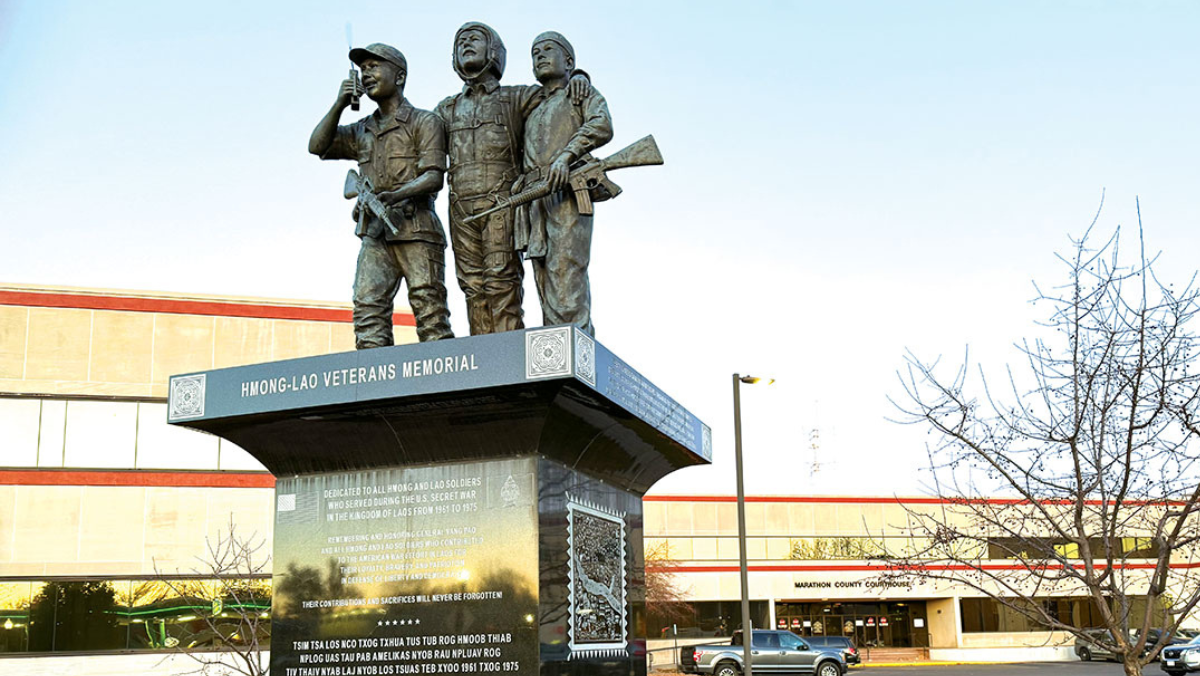
In 2016, the “Hmong-Lao Veterans Memorial” was unveiled on the grounds of the Marathon County Courthouse in Wausau, echoing the design of a similar memorial placed in front of the Fresno County Courthouse in California in 2005. Before the arrival of Hmong refugees, Wausau’s population was overwhelmingly white, with little racial diversity. The growing Hmong presence — reaching about 10 percent of the city’s population by the 1990s — was met with resistance and, at times, hostility. Complaints about cultural practices and even the mere presence of Hmong families surfaced. Many became victims of violent acts. One way Hmong refugees survived and eventually thrived was by forming community-based organizations to provide mutual support.
The Wausau memorial was the result of collaboration among veterans, elders from the immigrant generation, Wausau area leaders, and leaders of the nonprofit Hmong American Center. The statues depict two Hmong soldiers rescuing an American airman — a powerful symbol of sacrifice. Hmong motifs are engraved into all four corners at the top of the memorial, framing its structure with deep cultural significance. The memorial also includes a historical narrative featuring a map of the secret base at Long Cheng, a globe marking the locations of Laos and Wausau, and a story cloth depicting the refugee migration journey. Around the base, paver blocks bear the names of institutions and individual donors who helped to make the project possible. Notably, the memorial does not include names of those who served. (why?)
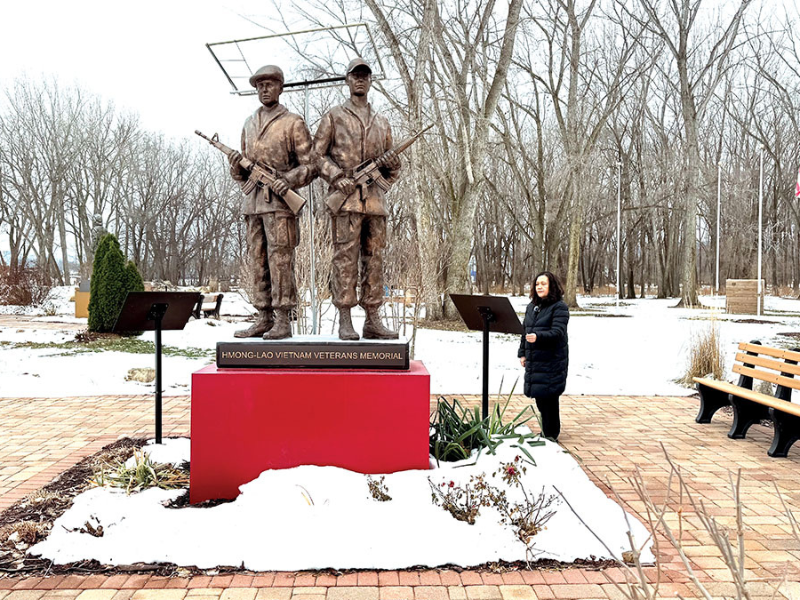
In 2019, the “Hmong-Lao Vietnam Veterans Memorial” was dedicated at Veterans Freedom Park in La Crosse. The memorial is described as a project built by the La Crosse community for the Hmong. This third memorial was the result of a collaborative effort led by Louie Ferris, president of a local chapter of the Korean War Veterans Association, together with leaders of the Wisconsin Lao Veterans of America (LVA). Their shared vision was clear: to ensure that future generations understand how the Hmong came to the United States and the extraordinary sacrifices they made during the Secret War in Laos. The memorial features statues modeled after two Hmong veterans — Za Xa Vue and Nao Tou Lor — both leaders of Wisconsin LVA. These figures stand as symbols of courage and the enduring legacy of Hmong soldiers. One plaque emphasizes the profound moral responsibility to remember those who died and to honor those who sought refuge in the United States. The other plaque lists the three fundraisers, thirteen deceased members of the Wisconsin Lao Veterans of America, and 26 members who were alive at the time of the dedication.
What do these memorials mean for Hmong and others? To what extent do the memorials encourage public discourse about Hmong involvement in the war? For many Hmong veterans and their families, these memorials are far more than monuments. They are acts of reclamation — asserting Hmong’s rightful place in U.S. history and honoring a generation that risked everything to protect their families and a country they had never seen. They stand as enduring reminders of sacrifice and of the long struggle for recognition. The cultural motifs carved into these memorials speak volumes. They remind us that these soldiers were not faceless fighters, but members of a vibrant community uprooted by war and thrust into global migration. Through inscriptions that narrate the Hmong role in the Secret War and the refugee journey, the memorials become educational spaces, inviting the public to engage with a history often overlooked. Do these memorials make Hmong in Wisconsin feel a deeper sense of belonging? Perhaps. But what is certain is this: they stand as a bold resistance to historical erasure.
Memorials like these remind us that belonging is never automatic — it must be claimed, often through struggle. When I stand before these memorials, I see more than bronze and granite. They are not abstract symbols. I see the faces of elders who fought in a war few Americans knew existed, and I hear echoes of the stories my parents and the many veterans and other community members told me in the hundreds of interviews I have conducted. These spaces affirm that our history matters. They challenge us to remember, to teach, and to engage in honest dialogue about the costs of war and the meaning of home. For me, they are a reminder that the journey from displacement to belonging is ongoing and that home is not just where we live. It is where our stories are told, where our sacrifices are remembered, and where our place in history is secured.